Monday, December 1, 2008

Clark's Doll Test & The Bluest Eye


I would also like to post another piece of writing that I believe relates to Face Forward’s message and cause quite appropriately. The message of Face Forward is to raise awareness, educate and promote a healthy self-image. By doing so we can affect people globally in a positive manner and specifically do so via the cosmetic industry and its relation to women of color. Due to our organization’s goals, the story and message of both Toni Morrison’s The Bluest Eye and a particular psychology study doll test raise important issues that revolve around similar issues that Face Forward wishes to address. Read the following response I wrote to understand how reading The Bluest Eye relates to certain issues concerning race that permeate our culture still today:

For this week’s response, I found a documentary called “A Girl Like Me”. It was a film made by a senior in high school interested in recreating Kenneth Clark’s well-known doll experiment from the 1950’s. Although Davis was only a high school student when she made the film and I do not know the validity of her study, it does focus on a lot of issues that are not only problems young African American children are obviously dealing with today, but also issues which draw significant parallels to Toni Morrison’s The Bluest Eye.
In the Morrison’s novel, the protagonist Pecola deals with not only a very difficult family life, but struggles with that fact that she doesn’t embody the qualities and make-ups of what white society of the time was projecting. In one haunting scene where Pecola and her brother are dealing with the fighting going on between their parents, Pecola envisions her body “disappearing” as a means to escape the pain of her family’s broken home. Morrison writes, “’Please, God,’ she whispered into the palm of her hand. ‘Please make me disappear.’ She squeezed her eyes shut. Little parts of her body faded away…Try as she might, she could never get her eyes to disappear. So what was the point? They were everything. Everything was there, in them. All of those pictures, all of those faces,” (45). Although Pecola’s exercise of imagining her own body disappear is a reaction to her troubled family life, it more broadly documents the feelings and self-esteem issues she has due to how society and those in her town treat her. She seems to maintain the idea that if only she were prettier her life would not be this difficult, and more specifically it reveals this never-ending obsession and belief that if only she had blue eyes everyone would like her.
However, Pecola’s mindset is not one that comes from merely her own imagination. Unfortunately Pecola deals with people saying and thinking terrible things about her throughout the whole story. These messages of negativity are reinforced by many people in the both her family and the neighborhood. In one passage where her mother Pauline (whose obsession with glamorous movie stars of the time doesn’t help normalize Pecola’s positive body image) has a short narrative, her mother says, “A right smart baby [Pecola] was. I used to like to watch her. You know they makes them greedy sounds. Eyes all soft and wet. A cross between a puppy and a dying man. But I knowed she was ugly. Head full of pretty hair, but Lord she was ugly,” (Morrison, 126). Although Pauline’s comments aren’t literally telling Pecola that “if you were beautiful, life would be better for you”, it just proves the mindset of the individuals that surround Pecola’s life. That even from those in her own home where a child is supposed to receive the most positive reinforcement and support, she sees nothing but degrading and deplorable behavior.
The documentary aptly highlights the standards of beauty that young women today still face. In the beginning of the short documentary, much of the discussion revolves around young girls and their idea of what ideal beauty is and the stories they have of friends or people they know trying to achieve this. The idea that fair or lighter skin color is still what is considered beautiful only further justifies Pecola’s very low self-esteem and body issues. When recreating Kenneth Clark’s doll test, the results are overwhelming in favor of African American children still choosing the white doll. Unfortunately it seems, (although this is only an isolated case whose study and method are not completely known to the audience) that the standard ideals of white beauty are still impacting children, over 50 years after Brown vs. the Board of Education case (for which the original test was conducted around). In one child’s response he literally says that the white doll is the “nice doll” because she is “white ”.
Unfortunately this is the reality that many are still facing, the reality that young children are somehow socially or indirectly being taught to prefer white over black, even in the simplest of examples, such as choice of dolls. Between this study and Morrison’s novel, these ideals of white beauty are strongly being reinforced by even the youngest and most innocent of our society, which makes it the most disheartening. Change needs to come from within the family and from within societal institutions for the hope to overcome this sad reality.

Pop Culture Link to Check Out:
http://www.youtube.com/watch?v=rjy9q8VekmE&feature=related

Activism: The Kent State Shootings


In our Introduction to Black Studies class, we are given weekly assignments to relate readings to certain advertisements, movies, music videos or images in pop culture. These assignments not only allow us as students to think critically about the readings, but allow us to process the information and turn the concepts and theories into something we relate to in every day life. The daily occurrences and products that the media feed us influence our thoughts and actions daily. Thus, the pieces and books we have throughout our course serve as valuable tools when we want to apply critical thinking to certain messages within pop culture.

One specific response I wrote relates to Face Forward’s progressive demand for change. This particular reading revolved around the role activism plays in our lives and highlights occurrences that took place on a college campus. Since Face Forward was born and created on a college campus, the organization certainly represents activism and its message for change to the status quo. Whether or not activism to change something revolves around a war or certain cause, it certainly has an impact on the status quo and gets people involved at a local level in the hope to make big waves on a bigger one. Here is one particular piece of writing that focuses on activism and in a drastic level affected a college campus amidst wild protesting:

When I think about activism, the images that come to mind are often from the Civil Rights movement. The 1960’s through the 1970’s were filled with individuals from all backgrounds coming together to fight for multiple causes. One such cause was the anti-war movement. This in particular, gained attention and momentum on college campus across the U.S. I chose to focus on the activism that took place as part of this anti-war movement on Kent State’s campus in Ohio, in May of 1970. Part of the reason I chose this was because I often used to ride around with the windows down in my Dad’s car singing Crosby, Stills, Nash & Young’s “Ohio” when I was younger. Not fully understanding the true meaning of the song, I would listen to my Dad tell his stories of when he took part in sit-in protests at the University of Maryland where students were broken up with tear gas and policemen. When four Kent State students were shot and killed during protests by the Ohio National Guard, a sad moment in U.S. history unfolded.
Activists recognize that change needs to occur somewhere in the social and moral makeup of societal order. James Jenning’s argues that praxis, or the practical application of learning, needs to take place out of the classroom. Crusader Ida B. Wells-Barnett, believed that true change in the African-American community had to come about through education but also “that the moral responsibility of Black intellectuals meant not only trying, socially and economically, to uplift the community, but also challenging racist order,” (Jennings, 38). Although my pop culture link doesn’t focus on the African-American community specifically, it recognizes that challenge against any institutionalized order needs to come about in order for any change to take place. And that is exactly what these college students did; they started a movement in their own community, literally outside their classrooms, and demanded social and political change. Unfortunately their activism was met with stronger tools than they knew how to handle.
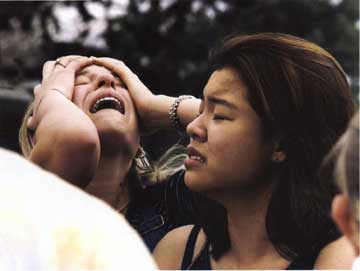
The events that took place at Kent State on May 4, 1970 shook the country and the “May 4 Massacre” is recognized as a tragic, confusing and controversial event in U.S. history. When U.S. forces begin killing their own citizens, the consequences are irreversible and astonishing. It proves to show how “the master’s tools never will never dismantle the master’s house,” (Lorde 23); that literally they will use whatever means necessary to keep the established order of things. When the “master” fought back using the most extreme tools they had at their disposal; weapons, not much could be done to defend the activists. I found that this tragedy proved to be one of the most literal translations of Lorde’s argument. Activism is a powerful tool, however, in this instance the U.S. government reverted to using even stronger tools in order to maintain its own control.


Pop Culture Link to Check Out:

http://www.youtube.com/watch?v=BSCSRI4oa8M&feature=related


To Be The Queen... - Duff


In our Black Studies class, one week’s reading assignment was “The Bluest Eye”, by Toni Morrison. I have read this book twice before in classes at William and Mary, making this the third time I’ve read it in college, and I read it once in high school, having read the book a total of 4 times now. The one thing I enjoy is that each time I’ve read it, I’ve learned something new.
I like this reading assignment this week because it ties in with my Community Action Project in my Black Studies class. Our CAP project addresses beauty in society and takes a look at and a stand for alternative forms of beauty coming from women of color instead of just the standard form that excludes many women. “The Bluest Eye” addresses this issue of standardized beauty. The book revolves around the lives of several young black girls living in an ignored black community with surrounding white areas. The story documents the challenge of the girls Frieda, Claudia, and particularly Pecola, to accept that they don’t meet their society’s standard of beauty of blue-eyed, blonde haired girls and the struggle they face inwardly to prove to themselves that they, too, are beautiful and ask why they were born black.

One point of the story that deals with beauty is Claudia’s hatred of Shirley Temple and Raggedy Ann dolls. Throughout the story, Shirley Temple, who was a standard of young girl beauty, is brought up multiple times in a negative way from Claudia. “I couldn’t join them in their adoration because I hated Shirley…What I felt at that time was unsullied hatred. But before that I had felt a stranger, more frightening than hatred for all the Shirley Temples in the world.” (Morrison, page 19) In this quote, Claudia speaks of “all the Shirley Temples”, or in other words, her generalization of white beauty and how she hates it because it’s the only beauty standard that exists for girls and she will never meet it. Another quote comes from Claudia speaking about white Raggedy Ann dolls. “Adults, older girls, shops, magazines, newspapers, window signs-all the world had agreed that a blue-eyed, yellow-haired, pink skinned doll is what every girl child treasured.” (Morrison, page 20) These quotes show that their world had a standard of beauty for girls that didn’t include girls of color. This idea can be damaging to girls, just as the story shows Pecola going mad at the end of the story wishing for blue eyes to be beautiful.
This idea of beauty is still a standard in our society, even among girls still. A recent movie that shows this standard is Little Miss Sunshine. In the movie, a young girl enters a pageant but her and her family realizes she could never win because she doesn’t meet the standard of beauty. What makes it more interesting is that she does meet the former blue eyes and blond hair standard for girls, but is still considered ‘ugly’ because she does not have the body or poise. This shows that a standard of beauty still exists in our society.


http://www.bigfanboy.com/pages/reviews/filmreviews/2006/littlemiss/ThePageant.jpg


Why is this beauty standard still enacting? Who is it that’s enforcing it?
Is it possible for our society not to have a standard of beauty?

What's Color Anymore? -Duff


If you turn on any TV, open any magazine, or view any gossip website, images of beauty standards lie in each example. Though I never actively ignored the African-American standards of beauty, I never paid any particular close attention growing up to what real black women are supposed to look like because I was young and a small white girl, not noticing much else besides Mac n’ cheese and how I could torment my sister. Recently, I have begun to take a closer notice at standards of beauty in the spectrum of women of color.

Sirena J. Riley also takes a stand at critiquing beauty standards placed upon African-American women. “As a black woman, I would love to believe that as a whole we are completely secure with our bodies. But that would completely miss the racism, sexism and classism that affect the specific ways in which black women’s beauty ideals and experiences of body dissatisfaction are often different from those of white women.” (Riley, page 357) She explains that white women are not the only race that has to deal with preconceived and often impossible images of what beauty perfection means, black women also face this.

The black female community has high appearance standards placed among them. The media focuses on beautiful women of color to create the standard. Riley explains this, “such beauties as Halle Berry, Jada Pinkett Smith, Nia Long, Iman and Angela Bassett. In the music scene there are the young women of Destiny’s Child, Lauryn Hill and Janet Jackson…Granted, these women don’t necessarily represent the waif look or heroin chic that plagues the pages of predominately white fashion and entertainment magazines, but come on. They are still a hard act to follow.” (Riley, page 364) One of the beauties listed, Beyonce of Destiny’s Child, has recently been critiqued in the media. She modeled for L’Oreal’s hair dye product and it seems as though the photo had been retouched to make her skin more white and hair longer and softer, making her look more like a white female rather than a black female. It had come with much criticism because this European company was turning Beyonce, a huge figure in all American culture, but especially in Black culture and giving her white features to appeal to white consumers. The company has taken away her ethnic identity and replaced it with white standards of beauty.

This image is a double edged sword for the black community. Not only does it make the ‘black’ version of Beyonce an unattainable beauty standard, but it makes the ‘white’ version of Beyonce an even more unattainable beauty standard. The addition of Perez’s racist whitewashed comment takes the advertisement to the extreme. Overall, this ad does more hurt than help and certainly represents more than just a sales pitch for a hair company.

http://perezhilton.com/2008-08-07-whitewashed

Is the term ‘whitewashed’ more offensive in the white or black community? Which of these coined the term? Besides being phonetic, do you think the ‘washed’ section is a racist comment referring to cleansing of the skin?

Sunday, November 30, 2008


In today’s analysis we once again see the power of the mythical norm at work. White is seen as the ideal and even white women have succumbed to idea that they must be physically perfect to be considered ideal. It is no longer enough that are white,


For my link I sent in a picture of two Barbies. One is white and one in black and they are both from what appears to be a dog care play set. I thought this picture related to the articles “Dyes and Dolls” by Ann duCille and “The Black Beauty Myth” by Sirena J. Riley. In duCille’s article she goes into an intense discussion of how Barbies have been portrayed throughout history. At one point in the article she states, “Today, Barbie dolls come in a virtual rainbow coalition of colors, races, ethnicities, and nationalities-most of which look remarkably like the prototypical white Barbie, modified only by a dash of color and a change of costume” (269). This representation of Barbie can be seen in my photo link. We see a white and a black Barbie, but the only difference between the two is that the have dyed the black Barbie’s skin brown and her hair black. Everything else about them is the same. They have the same face, clothes, and body type. This is very unrealistic as black women and white women tend to have different body types and the Barbie body type is unrealistic in the first place. In her article Riley writes “When asked to describe the ‘perfect woman,’ white women said she’d be about five foot ten, less than 120 pounds, blond and so on” (357-256). This description is a perfect description of a Barbie doll and it is totally unrealistic. Most women can not fit into this category. This description plays into the idea of the mythical norm and it also excludes black women from being the ideal women. Black women tend to be curvy and definitely never blonde. The fact that Mattel makes the black Barbie have the shape of a white person, as seen in the link, shows that they are trying to fit black Barbie into the socially constructed beauty ideals of the white world. This is unrealistic, however, and most certainly fosters feelings of inadequacy among blacks girls. They are given a beauty standard they can never attain.


Something to think about: In the picture link we see both Barbies as essentially identical except for the color of their skin and hair. This suggests an idea of equality between the two Barbie races, but in what way do we still see oppression of the Black female in the picture? Pay attention to the body positioning and the actions of each Barbie.


In today’s world everything is based off of how you look. Are you tall or short, pretty or ugly, black or white? This idea is shown within the cosmetic companies. The white creators of make-up have created make-up suitable for white people, but

barely any for blacks. It is as if they are trying to make black people seem ugly and thus inferior. This infatuation with looks can also be seen in the following analysis:

For my link I have a picture of a little baby boy. He is black, but he has blue eyes. This is something we don’t see very often and plays into a major topic of the book The Bluest Eyes by Toni Morrison. In this book there is a little black girl named Claudia and she has a slight obsession with her white baby doll. She doesn’t love it, but rather hates it because she cannot be like it. Morrison writes, “All the world had agreed that a blue-eyed, yellow-haired, pink-skinned doll was what every girl treasured” (p. 20). Claudia asked for the doll so that she “could examine it to see what it was that all the world said was loveable” (pg.21). Ultimately she found, however, that the doll was just made of ordinary parts
with nothing special about her. This idea plays into the idea of the mythical norm presented by Lorde in “Age, Race, Class, and Sex.” There is a category that society says people should fall into in order to be superior. This doll fits into that category, but as Claudia discovers there is really nothing special about the doll. This just illuminates the fact that the mythical norm is socially constructed. The baby in my link is an interesting case because he breaks the normal boundaries of these socially constructed ideas. Black babies aren’t supposed to have blue eyes. In this case he does not fit the mythical norm 100 percent, but rather crosses into it slightly with his blue eyes. This throws people off. You can see this when you yourself look at the picture. You look just a tad longer than you otherwise would if there was a black baby with brown eyes or a white baby with blue eyes. So here’s something for you to think about: In here article “Age, Race, Class, and Sex,” Lorde discusses the idea of the mythical norm. This idea is that the most ideal person in white, male, blue-eyed and blonde-haired, Christian, rich, and educated. This baby here sits outside of this mythical norm all except for his piercing blue eyes. Do you think this anomaly will make him more accepted within the mythical norm or do you think this will make people consider him to be even more deviant?

Hip Hop Caucus, Face Forward, and Change Through Popular Culture


Hip Hop culture has permeated all aspects of American pop culture and is a dominant trend in not just music, but movies, TV shows, other media, and fashion. If we recognize the strength and prevalence of popular Hip Hop culture across all social and economic classes, ethnic groups and gender, it can be used, as it has been in the past, as a means to initiate and inspire change. Face Forward is attempting to use its Star Power, and influence in the hip-hop community to make a difference. The “Respect My Vote” campaign is another organization that is making change through star power, popular culture, and hip-hop and could be expanded to do even more good in the community.


Elsa Davis noted the power that the words of Queen Latifah had on her life, as she notes that Latifah's “music and public image were intimately, almost inextricably, connected to [her] awakening personal and political identity,” (Davis, 128). Other artists and celebrities including T.I., who is a spokesperson for “Respect My Vote” , are personalities with whom young people can, “identify in a practical way,” (Davis, 129). Although T.I.'s lyrics may not always have an activist bent, the message and influence outside of his video persona can still be valuable.


Some may see our political system as broken and as a vestige of our nation's white patriarchal origins. We have yet to truly become a “democracy of the many rather than a republic ruled by a virtuous few,” (Robinson, 22) and those who are outside the “mythical norm” (Lorde, 116) still enjoy “limited freedom,” (Robinson, 22). While our system is flawed I believe that the political system is still a vehicle for change, and is more than just a “master's tool”. Unfortunately, more often than not, those involved in the political process, those who vote, and those who are elected, only represent the dominant power structures and “established power...has, in this country, always been antithetical to the interests of Black people,” (Cole, 26) and other groups who do not consist of white, protestant, middle class males. “Respect My Vote” is urging urban youth of America that has felt disenfranchised in the past, to have their voices heard and let them know that “what they think matters,” (Cole, 25).


“Respect My Vote” is using popular music and celebrity to encourage young people to register to vote. While this is a wonderful project, there needs to be more follow through. It is difficult for young people and working class people to find information about candidates, determine where their local polling places are, and obtain transportation to their polling places. In addition, this project could be taken a step further. Young people could be taught about the U.S. Political system, become acquainted with local government representatives, and given information about local issues, and grassroots organizations.


While this might be overly ambitious, helping people register to vote, providing candidate information, and providing transportation for people to reach the polling places could allow many people who may not have voted in the past due to age or attitude, to cast their ballot this year, maybe for the first time. A project could even start out small by picking a population of local high school seniors to educate and transport. Even if transportation is impossible we could map out routes on local bus schedules and distribute them. Local community groups, TV, and especially radio stations, are excited about this year's historic election and may be interested in donating vans or buses to shuttle people to polling places.


I have worked as a local election official for the past couple of years. During each election it has been evident that those who voted did not represent the local population. Lines of white men over the age of forty filled the elementary school gym. I only saw an occasional woman, a few people in their twenties, a random few high school/college students drug in by their parents, and I could count the non-white voters on my two hands. It made me frustrated and angry.

The young people who may potentially become involved in a program like this, and vote this year, may become involved by running as an elected official many years from now. Today our government may not represent the diverse communities in this country, but with education, inspiration, and hope, change is possible. Service focused members of government can focus on “changing system-based and dominant/subordinate social and economic relations and improving living conditions for Blacks and thereby, other communities,” (Jennings, 35). Once individuals are granted access to the power structures, for example government institutions, they can “make common cause with those others identified as outside the structures in order to define and seek a world in which we can all flourish,” (Lorde, 23) and where “our personal visions lay the groundwork for political action,” (Lorde, 23).


Links to Watch!

https://mailstore.wm.edu/wm/mail/fetch.html?urlid=3328b247e42c35ef460f927e00169a796&url=http%3A%2F%2Fwww.youtube.com%2Fwatch%3Fv%3Dw-pa7RERTG0%26feature%3Drelated

http://www.youtube.com/watch?v=UFvdSBqrMKE
https://mailstore.wm.edu/wm/mail/fetch.html?urlid=3328b247e42c35ef460f927e00169a796&url=http%3A%2F%2Fwww.youtube.com%2Fwatch%3Fv%3Db2o0vUf1TCs%26feature%3Drelated


http://www.hiphopcaucus.org/