Sunday, November 30, 2008


In today’s analysis we once again see the power of the mythical norm at work. White is seen as the ideal and even white women have succumbed to idea that they must be physically perfect to be considered ideal. It is no longer enough that are white,


For my link I sent in a picture of two Barbies. One is white and one in black and they are both from what appears to be a dog care play set. I thought this picture related to the articles “Dyes and Dolls” by Ann duCille and “The Black Beauty Myth” by Sirena J. Riley. In duCille’s article she goes into an intense discussion of how Barbies have been portrayed throughout history. At one point in the article she states, “Today, Barbie dolls come in a virtual rainbow coalition of colors, races, ethnicities, and nationalities-most of which look remarkably like the prototypical white Barbie, modified only by a dash of color and a change of costume” (269). This representation of Barbie can be seen in my photo link. We see a white and a black Barbie, but the only difference between the two is that the have dyed the black Barbie’s skin brown and her hair black. Everything else about them is the same. They have the same face, clothes, and body type. This is very unrealistic as black women and white women tend to have different body types and the Barbie body type is unrealistic in the first place. In her article Riley writes “When asked to describe the ‘perfect woman,’ white women said she’d be about five foot ten, less than 120 pounds, blond and so on” (357-256). This description is a perfect description of a Barbie doll and it is totally unrealistic. Most women can not fit into this category. This description plays into the idea of the mythical norm and it also excludes black women from being the ideal women. Black women tend to be curvy and definitely never blonde. The fact that Mattel makes the black Barbie have the shape of a white person, as seen in the link, shows that they are trying to fit black Barbie into the socially constructed beauty ideals of the white world. This is unrealistic, however, and most certainly fosters feelings of inadequacy among blacks girls. They are given a beauty standard they can never attain.


Something to think about: In the picture link we see both Barbies as essentially identical except for the color of their skin and hair. This suggests an idea of equality between the two Barbie races, but in what way do we still see oppression of the Black female in the picture? Pay attention to the body positioning and the actions of each Barbie.


In today’s world everything is based off of how you look. Are you tall or short, pretty or ugly, black or white? This idea is shown within the cosmetic companies. The white creators of make-up have created make-up suitable for white people, but

barely any for blacks. It is as if they are trying to make black people seem ugly and thus inferior. This infatuation with looks can also be seen in the following analysis:

For my link I have a picture of a little baby boy. He is black, but he has blue eyes. This is something we don’t see very often and plays into a major topic of the book The Bluest Eyes by Toni Morrison. In this book there is a little black girl named Claudia and she has a slight obsession with her white baby doll. She doesn’t love it, but rather hates it because she cannot be like it. Morrison writes, “All the world had agreed that a blue-eyed, yellow-haired, pink-skinned doll was what every girl treasured” (p. 20). Claudia asked for the doll so that she “could examine it to see what it was that all the world said was loveable” (pg.21). Ultimately she found, however, that the doll was just made of ordinary parts
with nothing special about her. This idea plays into the idea of the mythical norm presented by Lorde in “Age, Race, Class, and Sex.” There is a category that society says people should fall into in order to be superior. This doll fits into that category, but as Claudia discovers there is really nothing special about the doll. This just illuminates the fact that the mythical norm is socially constructed. The baby in my link is an interesting case because he breaks the normal boundaries of these socially constructed ideas. Black babies aren’t supposed to have blue eyes. In this case he does not fit the mythical norm 100 percent, but rather crosses into it slightly with his blue eyes. This throws people off. You can see this when you yourself look at the picture. You look just a tad longer than you otherwise would if there was a black baby with brown eyes or a white baby with blue eyes. So here’s something for you to think about: In here article “Age, Race, Class, and Sex,” Lorde discusses the idea of the mythical norm. This idea is that the most ideal person in white, male, blue-eyed and blonde-haired, Christian, rich, and educated. This baby here sits outside of this mythical norm all except for his piercing blue eyes. Do you think this anomaly will make him more accepted within the mythical norm or do you think this will make people consider him to be even more deviant?

Hip Hop Caucus, Face Forward, and Change Through Popular Culture


Hip Hop culture has permeated all aspects of American pop culture and is a dominant trend in not just music, but movies, TV shows, other media, and fashion. If we recognize the strength and prevalence of popular Hip Hop culture across all social and economic classes, ethnic groups and gender, it can be used, as it has been in the past, as a means to initiate and inspire change. Face Forward is attempting to use its Star Power, and influence in the hip-hop community to make a difference. The “Respect My Vote” campaign is another organization that is making change through star power, popular culture, and hip-hop and could be expanded to do even more good in the community.


Elsa Davis noted the power that the words of Queen Latifah had on her life, as she notes that Latifah's “music and public image were intimately, almost inextricably, connected to [her] awakening personal and political identity,” (Davis, 128). Other artists and celebrities including T.I., who is a spokesperson for “Respect My Vote” , are personalities with whom young people can, “identify in a practical way,” (Davis, 129). Although T.I.'s lyrics may not always have an activist bent, the message and influence outside of his video persona can still be valuable.


Some may see our political system as broken and as a vestige of our nation's white patriarchal origins. We have yet to truly become a “democracy of the many rather than a republic ruled by a virtuous few,” (Robinson, 22) and those who are outside the “mythical norm” (Lorde, 116) still enjoy “limited freedom,” (Robinson, 22). While our system is flawed I believe that the political system is still a vehicle for change, and is more than just a “master's tool”. Unfortunately, more often than not, those involved in the political process, those who vote, and those who are elected, only represent the dominant power structures and “established power...has, in this country, always been antithetical to the interests of Black people,” (Cole, 26) and other groups who do not consist of white, protestant, middle class males. “Respect My Vote” is urging urban youth of America that has felt disenfranchised in the past, to have their voices heard and let them know that “what they think matters,” (Cole, 25).


“Respect My Vote” is using popular music and celebrity to encourage young people to register to vote. While this is a wonderful project, there needs to be more follow through. It is difficult for young people and working class people to find information about candidates, determine where their local polling places are, and obtain transportation to their polling places. In addition, this project could be taken a step further. Young people could be taught about the U.S. Political system, become acquainted with local government representatives, and given information about local issues, and grassroots organizations.


While this might be overly ambitious, helping people register to vote, providing candidate information, and providing transportation for people to reach the polling places could allow many people who may not have voted in the past due to age or attitude, to cast their ballot this year, maybe for the first time. A project could even start out small by picking a population of local high school seniors to educate and transport. Even if transportation is impossible we could map out routes on local bus schedules and distribute them. Local community groups, TV, and especially radio stations, are excited about this year's historic election and may be interested in donating vans or buses to shuttle people to polling places.


I have worked as a local election official for the past couple of years. During each election it has been evident that those who voted did not represent the local population. Lines of white men over the age of forty filled the elementary school gym. I only saw an occasional woman, a few people in their twenties, a random few high school/college students drug in by their parents, and I could count the non-white voters on my two hands. It made me frustrated and angry.

The young people who may potentially become involved in a program like this, and vote this year, may become involved by running as an elected official many years from now. Today our government may not represent the diverse communities in this country, but with education, inspiration, and hope, change is possible. Service focused members of government can focus on “changing system-based and dominant/subordinate social and economic relations and improving living conditions for Blacks and thereby, other communities,” (Jennings, 35). Once individuals are granted access to the power structures, for example government institutions, they can “make common cause with those others identified as outside the structures in order to define and seek a world in which we can all flourish,” (Lorde, 23) and where “our personal visions lay the groundwork for political action,” (Lorde, 23).


Links to Watch!

https://mailstore.wm.edu/wm/mail/fetch.html?urlid=3328b247e42c35ef460f927e00169a796&url=http%3A%2F%2Fwww.youtube.com%2Fwatch%3Fv%3Dw-pa7RERTG0%26feature%3Drelated

http://www.youtube.com/watch?v=UFvdSBqrMKE
https://mailstore.wm.edu/wm/mail/fetch.html?urlid=3328b247e42c35ef460f927e00169a796&url=http%3A%2F%2Fwww.youtube.com%2Fwatch%3Fv%3Db2o0vUf1TCs%26feature%3Drelated


http://www.hiphopcaucus.org/

Maintaining Norms and Glamorizing Racist/Sexist Imagery: The Pop Music Video

To Watch the Disturbia Video:
http://www.youtube.com/watch?v=a6zdhHLvT7k

Music Videos today are a launching pad for misogyny and objectification of women. It is important for consumers of popular culture images to think critically about what they are absorbing. Every aspect of a music video is chosen for a reason. Nothing is random. Women in music videos are presented in a way that maintains traditional gender roles, racial stereotypes, and beauty standards. Rihanna’s Disturbia video is an excellent example of covert racism and misogyny in popular culture.

Rihanna's new and incredibly popular music video depicts scenes from a 19th century mental institution. While the thrust of the video maintains themes of 'insanity' (and marginalizes individuals who suffer from mental illness), the imagery used smacks of slave bondage, sexualized violence, and the idea of difference as deviance.

Throughout the video, the black female protagonist is restrained in multiple ways. First, she has shackles around her ankles or neck, and then she is pinned, vulnerable, in a room with her arms restrained and her body completely exposed. hooks writes, “The prideful, arrogant, and independent spirit of the African people had to be broken so that they would conform to the white colonizer’s notion of proper slave demeanor.” (hooks, 20) These video images could be interpreted as sexualized imitations of slave bondage.

While this video is attempting to be sexy and edgy, and maintain Rihanna's reputation as a “good girl gone bad,” Disturbia makes light of the “sadistic misogynist acts of cruelty and brutality that were far beyond seduction,” (hooks, 28) that occurred during the centuries of slavery. “Since woman was designed as the originator of sexual sin, black women were naturally seen as the embodiment of female evil and sexual lust. They were labeled jezebels and sexual temptresses and accused of leading white men away from spiritual purity into sin,” (hooks, 33). During one memorable scene Rihanna writhes on a white male mannequin, fulfilling the role of “the evil sexual temptress, the bringer of sin into the world. Sexual lust originated with her and men were merely the victims of her wanton power,” (hooks, 29). However, while conjuring this image there is a failure to recognize the reality of the experience of the black woman during the 17th, 18th, and 19th centuries when she was subject to acts of “institutionalized terrorism,” (hooks, 27) more specifically rape. As Lorde writes, “rape is not aggressive sexuality, but sexualized aggression,” (Lorde, 120). The viewer is allowed to imagine this “sexualized aggression,” in the video. The main character is restrained, in one scene veiled and faceless, made to be different, a hypersexualized and an available 'other', who can easily be consumed with no fear of moral or social repercussions. While no rape occurs in the video, the viewer can surely imagine it.

In addition to the images of bondage and sexualized violence, there are constructions of difference that include the different being deviant. This video does not demonstrate, “human difference, but...human deviance,” (Lorde, 116). The characters in the video include effeminate men, a transgender female, a restrained black female, and a group of exotic 'other' back up dancers that perform in pulsating, orgy-like movement. All of the non-white characters or characters who do not perform their gender in traditional ways, are different and deviant, and presented as insane, reinforcing traditional gender performance, white patriarchal hegemony, and constructions of difference.

Self Image

Face Forward is part of the battle to eliminate white privilege in terms of beauty concepts. The song “My Humps” emphasizes the stereotypical “ideal” features possessed by black women, but ironically displays images in the music video of white-idealized women. The following analysis gives further insight into what Face Forward hopes to change.
http://www.youtube.com/watch?v=CXKxs8Ge_9g
In the “Black Beauty Myth”, Sirena J. Riley explains that, despite popular belief, black women too have insecurities about their body weight. These insecurities are even more complex, she explains, because of the intersections of sexism, racism, and gender. But women’s studies and black studies never really address these issues; she describes how “whenever body image was researched and discussed as a project,…black women were barely a footnote (Riley, 363).” The black female image is very prominent in the media, and especially in rap music, though. She explains how “many songs have been written paying homage, however objectifying, to the black behind (Riley, 365).” I chose this video link as an example of that. The lyrics of the song show a clear example…however upon observance of all the women in the video, one will notice that all of the women fit the white American beauty ideal of slimness…their “lovely lady lumps” are honestly fairly lacking, especially in comparison to such luscious example of black beauty as Queen Latifah. Though when one listens to the lyrics which seem to “empower” women through their sexuality, their “power to arouse them and to give or withhold sex,” is the same issue that supposedly fuels “sexual fantasies and the [male] desire for revenge (73, Kimmel in hooks’ We Real Cool).
This all leads me to wonder: How might young black women be educated away from the media and music images that surround her? What must be done to help her retain a healthy self-image?

Age, Race, Class, and Sex

One of the key factors that Face Forward hopes to address is minority oppression through media-instilled beauty and race concepts. The following analysis gives a vivid example of this conflict as shown in an advertisement.
http://www.blackcollegebands.com/forums/gaming-technology-forum/7309-psp-white-vs-black.html
The paper “Age, Race, Class, and Sex: Women Redefining Difference” really hit home with me this week. It delved into the struggle that a member of an oppressed minority goes through when he or she is part of another oppressed group, whether it is for age, sexual orientation, gender, or any of the other differences we choose to look down upon. The author notes that “we speak not of human difference, but of human deviance”. This deviance has caused strife for black women, especially in their efforts to support the modern women’s movement, where “there is a pretense to a homogeneity of experience covered by the word ‘sisterhood’ that does not in fact exist.” There is no such pretense in these images, though their original purpose was perhaps not to personify a rivalry between black and white women. The clear support though in this battle is for that of the shining white figure, always very present and visible while the black woman fades into her dark background. It is clear though, especially in the second (lower) picture, that both are serving the same purpose: that of two objectified, sensualized females meant to draw the (mostly) male PSP consumers to lustfully admire the cat fight and think with further excitement about the product being advertised. It is curious, though, that while the white woman has the more prominent place and a seemingly more powerful role in both images, she is the more objectified of the two. So while she escapes the blatant racial inferiority implied by the image, she falls more so victim to the role expected of her as a woman. The white woman seems to be a clear link back to the fact that “the master’s tools will never dismantle the master’s house…”. The author ends on an encouragement for us to “recognize the differences among women who are our equals, neither inferior nor superior, and devise ways to use each others’ differences to enrich our visions and our joint struggles.” This image denotes how much of a necessity this recognition and enrichment is.

Queen Latifah - Ladies First

http://www.youtube.com/watch?v=xCR1akhEfvQ

This video highlights some of the most important features of Face Forward. In its opening, you will notice that the pictures of Madame C.J. Walker, Sojourner Truth, Angela Davis, and Winnie Mandela, four women who achievements as independent woman, and further, as independent black women, rarely receive the credit they deserve. The video highlights this by flashing these images first, challenging the viewer to see how many he or she recognizes, to see how much knowledge the viewer has of the amazing accomplishments of African American women. Our organization too emphasizes the subordinate role that African American women and other women of color receive in society. Throughout the video Latifah's lyrics and choice of imagery emphasize the similarities between the conflicts of black vs. white (images of apartheid conflicts in South Africa) and (much more subtly through lyric and clothing choice) the conflicts of man vs. woman. This similarity is described all too clearly by Face Forward and its efforts towards racial and gender equality. Audre Lorde explains how "the Master's tools will never dismantle the master's house. They may allow us temporarily to beat him at his own game, but they will never enable us to bring about genuine change ("The Master's Tools Will Never Dismantle the Master's House", 23)." Latifah carries up this cry of truth in her refrain, 'Ladies First", whose multuple meanings hit the listener in waves. The first wave is our knowledge of the common phrase of "politeness", a chivalric cover (and in in so many ways, a blatant lie) for the patriarchal norms which always put women second to men. The second wave is the specific choice of the word "lady", which calls to attention Latifah's superior status (and especially title, in her choice of the name "Queen"). This in itself is a statement, as not only a woman but an African American woman is celebrating status (which explains the choice of C.J. Walker in the beginning, see http://findarticles.com/p/articles/mi_m2838/is_n2_v28/ai_15787237/pg_6?tag=artBody;col1). Further, the use of "Ladies First" in combination with images of significant advocates for equality (of gener and race) suggest that women can and should be at the forefront of the civil rights movement that continues today. Latifah's video identifies and encourages strong solutions for the same problems Face Forward strives to change, and thus earns a spot on the About Us page of the Face Forward website.

Wednesday, November 12, 2008

The Importance of Activism

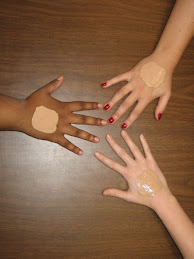
The Face Forward Organization features some of the biggest celebrites in the world. On top of our busy schedules, we always find time to plan and organize events for topics that we feel strongly for. We recognize that our emphasis for cosmetic companies to supply foundations for women of all ethinicities extends farther than just "looking pretty". Being able to walk into a drugstore and find a shade of makeup that fits your skin tone is a wonderful experience. You don't feel like an outcast based on a physical atribute of ourself that you had no control over.
In a world where having a ligther skin tone is ideal, we want to make this known that this notion is not correct. Every skin color is beautiful!!! Every person has the right to purchase a product unique to them.
Please us help in our effort by becoming passionate about your efforts. Get out in the world and make your voice heard. This world can only become more beautiful.

FACE FORWARD PSA

Face Forward is releasing a brand new PSA. The PSA features our wonderful celebrities urging consumers to think about the lack of available product for women of different skin shades. Get a first glimpse of the PSA on our website (www.faceforward.wikispaces.com) before it is released to the public.

Letter Writing Campaign

The letter writing campaign has started and is in full effect. Over the past two days of tabling in the Sadler Center at the College of William and Mary, we have received over 110 signed letters in support of our goal to make makeup available to all women of all skin types and shades. If you want to help us out, bring yourself and your friends to the Sadler Center for the remainder of the week (November 13 and 14). We are right in front of the dining hall. We will be there for the lunch hours. But remember, if you can't make it, visit our website, print the letter, John Hancock it, and throw it the mail (preferably in an envelope with a stamp). The addresses of all the companies that we will be sending the letters to are posted right underneath. Send a letter to one company or send them to all the companies. If you want, feel free to send a personally typed letter in the envelope in addition to ours. Thank you guys for all your support.

P.S. Something special must be in the water. The creative juices of the Face Forward members are flooding the streets. There are so many amazing ideas for future projects and goals. Keep visiting the blog and the website to keep up with what we doing.